'%20fill='%232E1091'/%3e%3c/svg%3e)
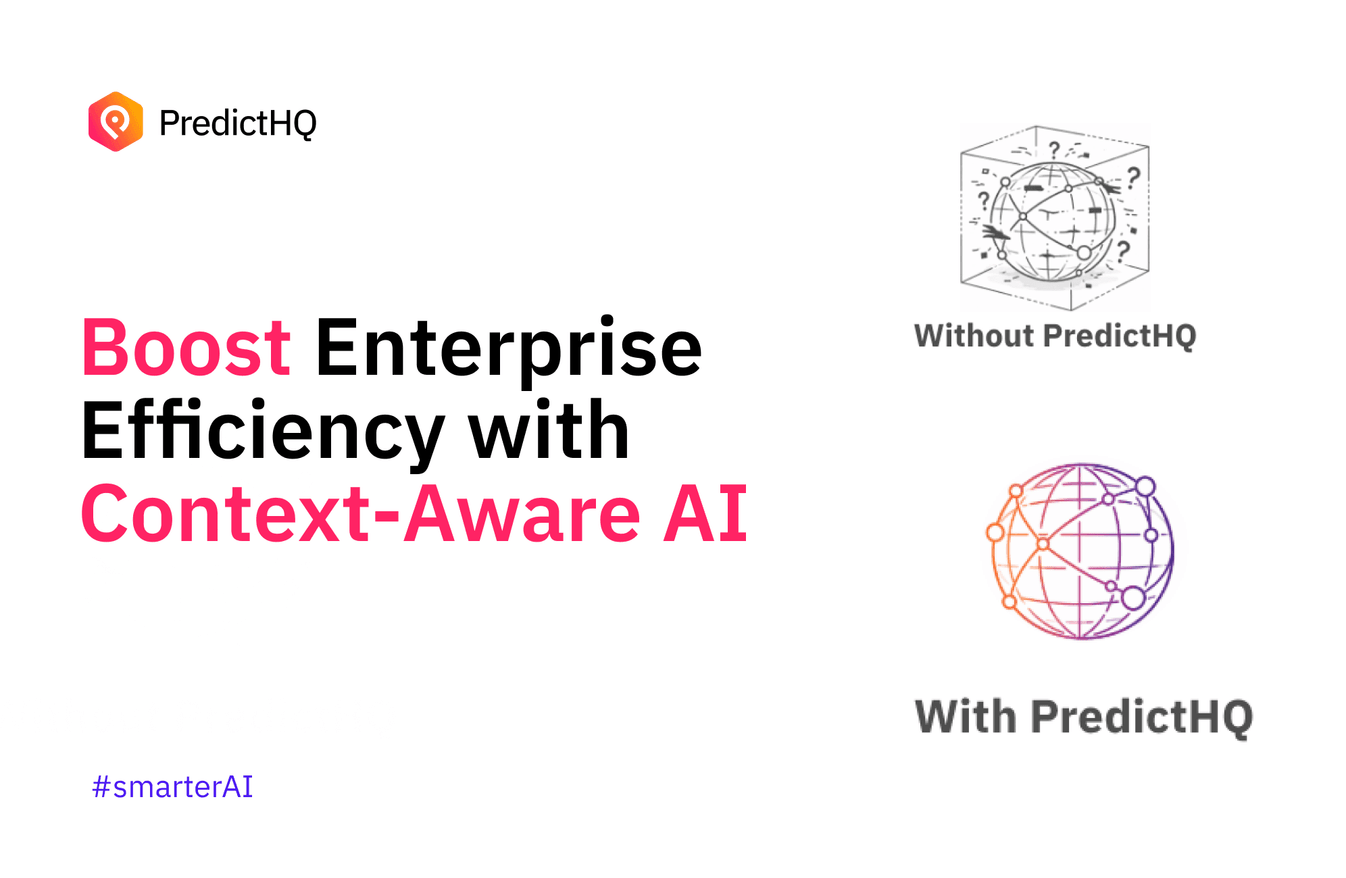
Boost Enterprise Efficiency with Context-Aware AI

Share
'%3e%3cpath%20fill='%23ACA8BC'%20d='M13.714%2010.623%2020.416%203H18.83l-5.822%206.617L8.36%203H3l7.028%2010.008L3%2021h1.588l6.144-6.99L15.64%2021H21M5.16%204.171H7.6l11.227%2015.715h-2.44'/%3e%3c/g%3e%3cdefs%3e%3cclipPath%20id='clip0_1_4'%3e%3cpath%20fill='%23fff'%20d='M0%200h24v24H0z'/%3e%3c/clipPath%3e%3c/defs%3e%3c/svg%3e)
Context-aware AI is transforming how enterprises operate by integrating real-time contextual information into artificial intelligence systems to deliver more precise, adaptive, and efficient business outcomes.
Unlike traditional AI models that process data in isolation, context-aware systems automate complex decisions. PredictHQ enhances these systems by delivering tailored insights, automating decisions, and enhancing enterprise outcomes, enabling them to account for factors like major events, cultural festivals, sport tournaments, conferences, holidays, and other events that impact business operations. This approach enables enterprises to achieve significant efficiency gains through intelligent process automation, reduced operational costs, and enhanced decision-making accuracy. As organizations increasingly adopt context-driven automation and scalable AI ecosystems, understanding the strategic implementation of context-aware AI becomes essential for maintaining competitive advantage in today's data-driven business landscape.
What is Context-Aware AI in Enterprise Environments
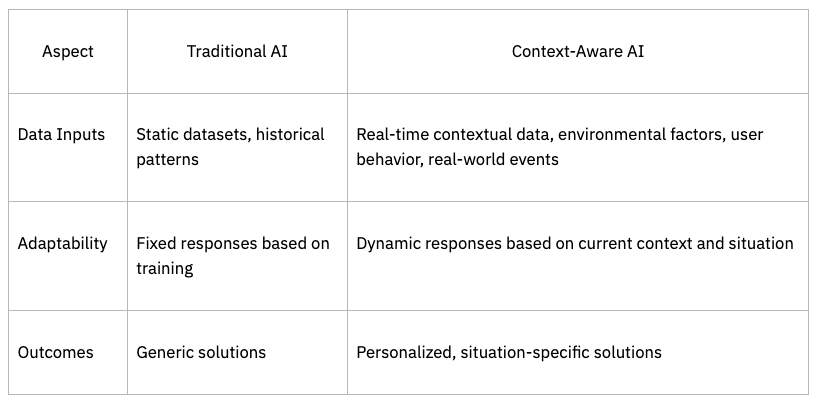
Context-aware AI refers to artificial intelligence systems that interpret and utilize real-time contextual information—such as user role, workflow status, or business data streams.This technology represents a fundamental shift from traditional AI approaches by incorporating environmental awareness and situational understanding into automated processes.
The foundation of context-aware AI lies in its ability to blend short-term memory, which captures immediate user or workflow context, with long-term institutional knowledge to create more resilient and adaptive business processes. PredictHQ contributes to this foundation by providing real-world event data that acts as external context, informing AI systems about events that can significantly impact business operations. This combination enables intelligent process automation that responds dynamically to changing business conditions rather than following rigid, predetermined rules.
Context-driven automation powered by these systems can process multiple data types simultaneously, including structured business data, unstructured documents, user behavior patterns, and external environmental factors. This comprehensive data integration allows AI models to make more informed decisions that align with current business realities and organizational objectives.
How Context-Aware AI Enhances Efficiency and Decision-Making
Context-aware AI delivers measurable improvements in enterprise efficiency through its ability to process complex, multi-dimensional information and adapt responses to specific business situations. The travel and hospitality sector saw an increase of 22% from the use of AI and personalization in their chatbots.
Multimodal AI systems, which analyze data from multiple sources including text, speech, sensor data, and visual inputs, enable faster and more precise decision-making by capturing nuanced context that single-mode systems might miss. PredictHQ's real-world demand intelligence adds another crucial dimension by providing context about external events that can influence business operations—from weather patterns affecting supply chains to conferences driving hotel demand spikes. This comprehensive approach allows organizations to identify patterns and opportunities that would otherwise remain hidden in isolated data silos.
The operational impact of context-aware AI manifests across three critical areas:
- Process Automation: Streamlines complex workflows by understanding context-specific requirements and automatically adjusting processes based on current conditions and external events.
- Knowledge Retrieval: Delivers relevant information precisely when needed by understanding the user's role, current task, decision-making context, and relevant external factors.
- Exception Handling: Identifies and responds to unusual situations by comparing current context against historical patterns, organizational policies, and real-world event impacts.
Key Benefits of Implementing Context-Aware AI
Organizations implementing context-aware AI systems experience substantial measurable benefits across multiple operational dimensions. Research indicates that enterprises can achieve response accuracy improvements of 60-80%, knowledge retrieval time reductions of 35-50%, response time decreases of 40-60%, and data transmission cost savings of 50-70%.
The primary benefits include:
Cost Reduction: Automated context-aware decision-making reduces manual intervention requirements and minimizes errors that lead to costly corrections. PredictHQ's event data helps prevent costly oversights by alerting AI systems to external factors that could impact operations.
- Improved Compliance: Contextual understanding of regulatory requirements ensures that automated processes maintain compliance across different business scenarios.
- Enhanced Collaboration: Context-aware systems facilitate better information sharing by understanding user roles and providing relevant data to the right stakeholders.
- Security Through Edge Processing: Edge AI deployment enables localized processing that reduces data transmission risks while maintaining real-time contextual insights.
Edge AI, which refers to the deployment of artificial intelligence models directly on hardware near the data source, plays a crucial role in context-aware systems by reducing latency and enabling immediate contextual responses without compromising sensitive data through cloud transmission.
Emerging Trends Driving Context-Aware AI Adoption
Several technological innovations are accelerating enterprise adoption of context-aware AI systems, with over 75% of enterprises expected to deploy production-ready AI systems impacting core business operations.
- Agentic AI: Autonomous systems that proactively initiate workflows and make decisions based on contextual triggers, including real-world events.
- Multimodal AI: Integration of text, voice, image, sensor data, and external event data processing for comprehensive contextual understanding.
- Model Context Protocol (MCP): Standardized frameworks for maintaining context continuity across different AI systems and applications.
- Reasoning-Centric AI: Advanced logic processing that enables complex decision-making based on contextual evidence.
- Retrieval-Augmented Generation (RAG): Dynamic information retrieval that enhances AI responses with real-time, relevant data.
- Edge AI: Local processing capabilities that provide immediate contextual responses while maintaining data security.
These trends collectively support the development of scalable AI ecosystems that can adapt to diverse business requirements while maintaining consistent performance and contextual awareness. Standardized AI communication protocols ensure context continuity and consistency across integrated systems, enabling seamless information flow and coordinated decision-making.
Strategies to Build AI Models that is Real-World Aware
Data Integration and Enrichment
Comprehensive data integration forms the backbone of effective context-aware AI systems, enabling models to access and learn from multifaceted business realities. Data enrichment processes enhance raw inputs with real-world, contextual layers—such as integrating event data, weather patterns, market signals, or customer behavior indicators—to boost model relevance and accuracy.
PredictHQ specializes in providing this critical real-world demand intelligence layer, offering comprehensive event data that includes everything from natural disasters and public holidays to conferences, concerts, and sporting events. This external context enables AI systems to understand not just internal business patterns, but also how external factors influence operations and customer behavior.
Successful data integration requires unifying structured business data with behavioral signals and real-world event feeds. Organizations should establish data pipelines that can process diverse information sources while maintaining data quality and consistency. This integration enables AI models to understand not just what is happening, but why it's happening and what contextual factors might influence outcomes.
Essential steps for successful data integration include:
- Establishing standardized data formats across all sources.
- Implementing real-time data validation and quality monitoring.
- Creating automated enrichment processes that add contextual layers to raw data, including real-world demand intelligence.
- Developing secure data sharing protocols that maintain privacy while enabling comprehensive analysis.
Leveraging Retrieval-Augmented Generation (RAG)
Retrieval-Augmented Generation (RAG) is an AI architecture that combines large language models with external information retrieval systems, enabling on-the-fly access to up-to-date, authoritative knowledge. This approach significantly enhances context awareness by allowing AI systems to access relevant information dynamically rather than relying solely on training data.
Recent advances in RAG implementation have demonstrated substantial improvements in accuracy. Anthropic's contextual retrieval method cuts failed retrievals by 49%, improving AI search accuracy by better understanding the context of information requests and retrieving more relevant results.
RAG implementation in enterprise scenarios follows this process:
- Query Analysis: The system analyzes user requests to understand context and intent.
- Information Retrieval: Relevant documents, data, and real-world event information are retrieved from enterprise knowledge bases and external sources like PredictHQ.
- Context Integration: Retrieved information is combined with the user's current context, workflow status, and relevant external events.
- Response Generation: The AI generates contextually appropriate responses using both retrieved information and situational awareness.
The Future of Context-Aware AI in Enterprise Efficiency
Context-aware AI is redefining enterprise intelligence—combining domain expertise, event data, and continuous learning to deliver smarter, more adaptive decision-making. As these systems evolve, PredictHQ’s real-world demand intelligence will be essential for providing the external context that makes AI truly situationally aware. Organizations that invest in this fusion of internal and external context today will gain lasting efficiency, agility, and competitive advantage in an increasingly dynamic world.
Join leaders builder smarter AI with PredictHQ. Schedule a demo.